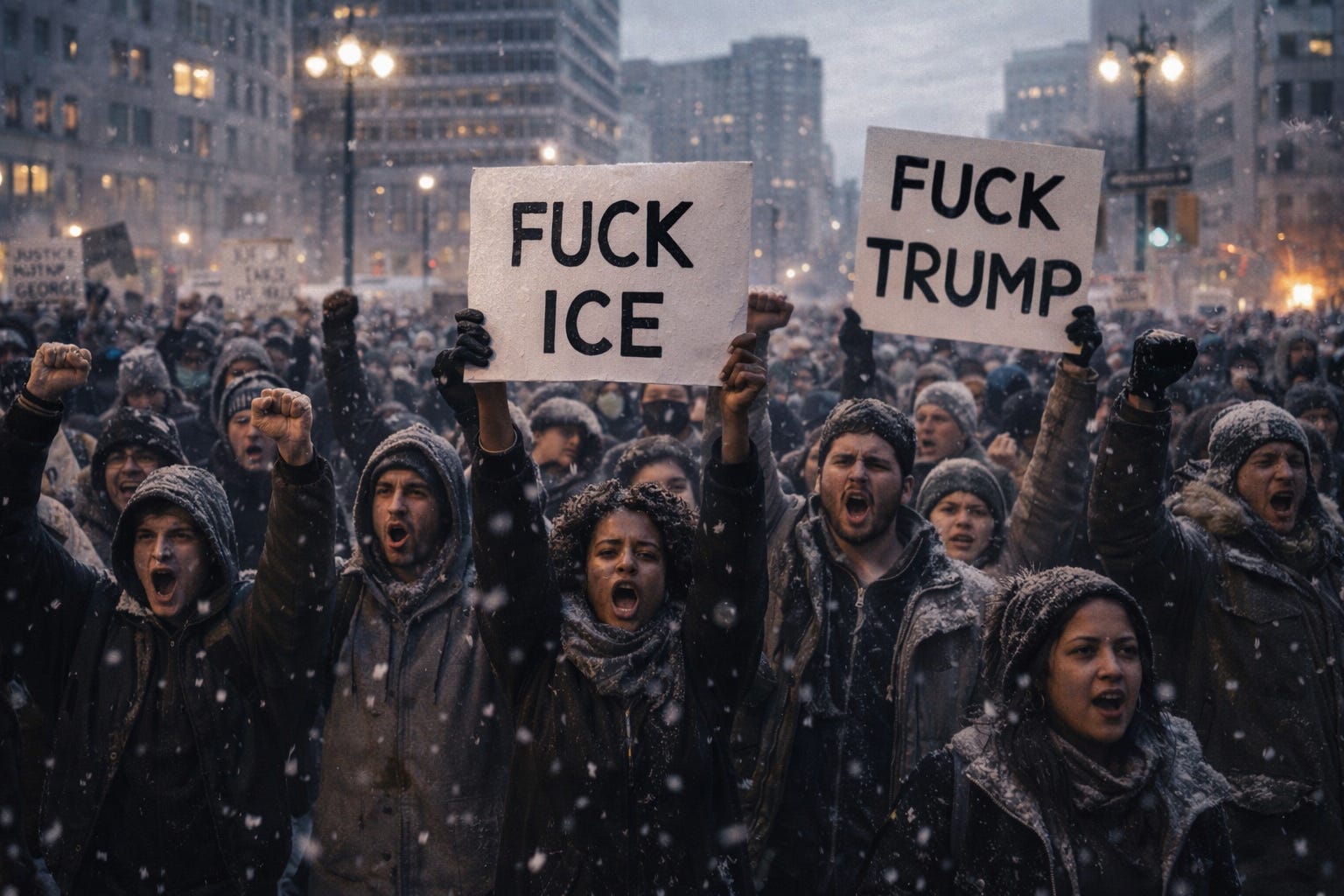
We’re not watching this presidency drift off course.
We’re watching Donald Trump strike the match and dare the rest of us to pretend it’s just bad weather — while a beautiful American city and the people who live there pay the price.
Thanks for reading! Subscribe for free to receive new posts and support my work.
I’m not watching this presidency drift off course.
We’re watching Donald Trump strike the match and dare the rest of us to pretend it’s just bad weather — while a beautiful American city and the people who live there pay the price.
I’m writing this from bed, not as metaphor, but because it strips away pretense. I don’t get to treat escalation as abstract. I don’t get to assume I’ll just “deal with it later.” When power starts sounding like force, the consequences are immediate — and some bodies absorb them first.
That’s the vantage point I’m writing from.
It’s arson from my view.
Trump doesn’t need tanks in the streets Even though clearly that’s
his wet dream.He just needs to keep threatening unconstitutional force — unloading federal agents into cities that don’t invite them, itching to invoke the Insurrection Act to federalize troops against states that explicitly don’t want it — until something snaps.
This is not speculation. It’s in the news. Trump has publicly threatened to use the Insurrection Act — a rarely used 19th-century law that lets a president deploy federal forces domestically — in Minneapolis in response to protests, even though local leaders aren’t asking for federal help and have denounced the federal response as an invasion.
That’s not law and order.
That’s a playbook for letting power edge past constitutional limits.
Let’s be clear: the Insurrection Act was written in 1807. It was meant for very narrow circumstances — rebellion that makes enforcement of laws impracticable, or a state requesting federal aid. What Trump is dangleding like a threat is showing a willingness to push that law into a political weapon, not a constitutional tool — and that’s the real danger.
And make no mistake: Minnesota isn’t asking for this federal brutality. Local officials in Minneapolis and across the state have pushed back, condemned the violence, and tried to de-escalate. They’re resisting not because they’re weak, but because they understand that sending more force into their streets won’t calm anything — it provokes more conflict.
This isn’t incompetence.
This is a strategy.
Used right, the Insurrection Act should be a last resort, not a “we’ll do it if you don’t bend over” threat. Deploying federal troops against civilians in cities that don’t want them is not constitutional norm; it’s authoritarian play-acting. And people across the country — not just Minnesota — are watching.
We’ve seen versions of this pattern before: leaders who hollow out checks and balances, normalize exceptional force, and treat emergency powers as routine. Provocation isn’t a bug. It’s the engine.
And it doesn’t stay contained.
When a nuclear-armed country starts flirting openly with domestic military force, ignoring constitutional limits and federalism, the rest of the world notices. Allies hedge. Adversaries probe. Lines that used to mean something start looking negotiable.
World wars don’t start because everyone suddenly loses their mind.
They start because people convince themselves this is fine — until it very clearly isn’t.
People keep calling this a five-alarm fire.
It’s not.
It’s Lahaina — dry ground, deliberate sparks, ignored warnings, and leadership that stands around acting surprised while everything burns. By the time consensus shows up, the damage is already done.
Writing this from bed removes the cosplay.
I don’t get to posture. I don’t get to say “I’ll bounce back.”
When escalation shows up in language, my body reacts before my brain finishes its coffee.
Call that trauma if it helps you sleep.
I call it pattern recognition.
People who can run, relocate, protest, or recover quickly get to experience political danger as debate. People who can’t — disabled, chronically ill, medically fragile — experience it as consequence. Access shrinks. care becomes conditional. Safety becomes a maybe.
So when someone tells me “calm down,” what I hear is:
this hasn’t touched me yet.
The real danger right now isn’t panic.
It’s normalization.
Every time we wave off Trump’s threats as “just politics,” we feed them. Every time we pretend constitutional violations are rhetorical instead of real, the fire spreads. Every time we wait for a cleaner moment to push back, there’s less left to protect.
Pulling together doesn’t mean agreeing on everything.
It means agreeing on one hard line: you don’t turn state power against civilians and call it stability.
This doesn’t end with one state.
It doesn’t end with one election.
And it sure as hell doesn’t end at our borders.
I’m not writing this because I’m afraid of fear.
I’m writing it because pretending not to see the fire has never put one out.
Some of us are watching it spread from beds, couches, and hospital rooms — not because we’re weak, but because our bodies already know what unchecked power feels like up close.
And we’re telling you, plainly:
This is how countries burn.
If you’re wondering why I’m writing from bed: I’m chronically ill and rebuilding after several years of medical collapse. I have a GoFundMe to cover basic survival and care while I keep writing and paying attention. It’s linked here if you want it. No pressure. Help Maci Rebuild After Years of Illness
Thanks for reading! Subscribe for free to receive new posts and support my work.